
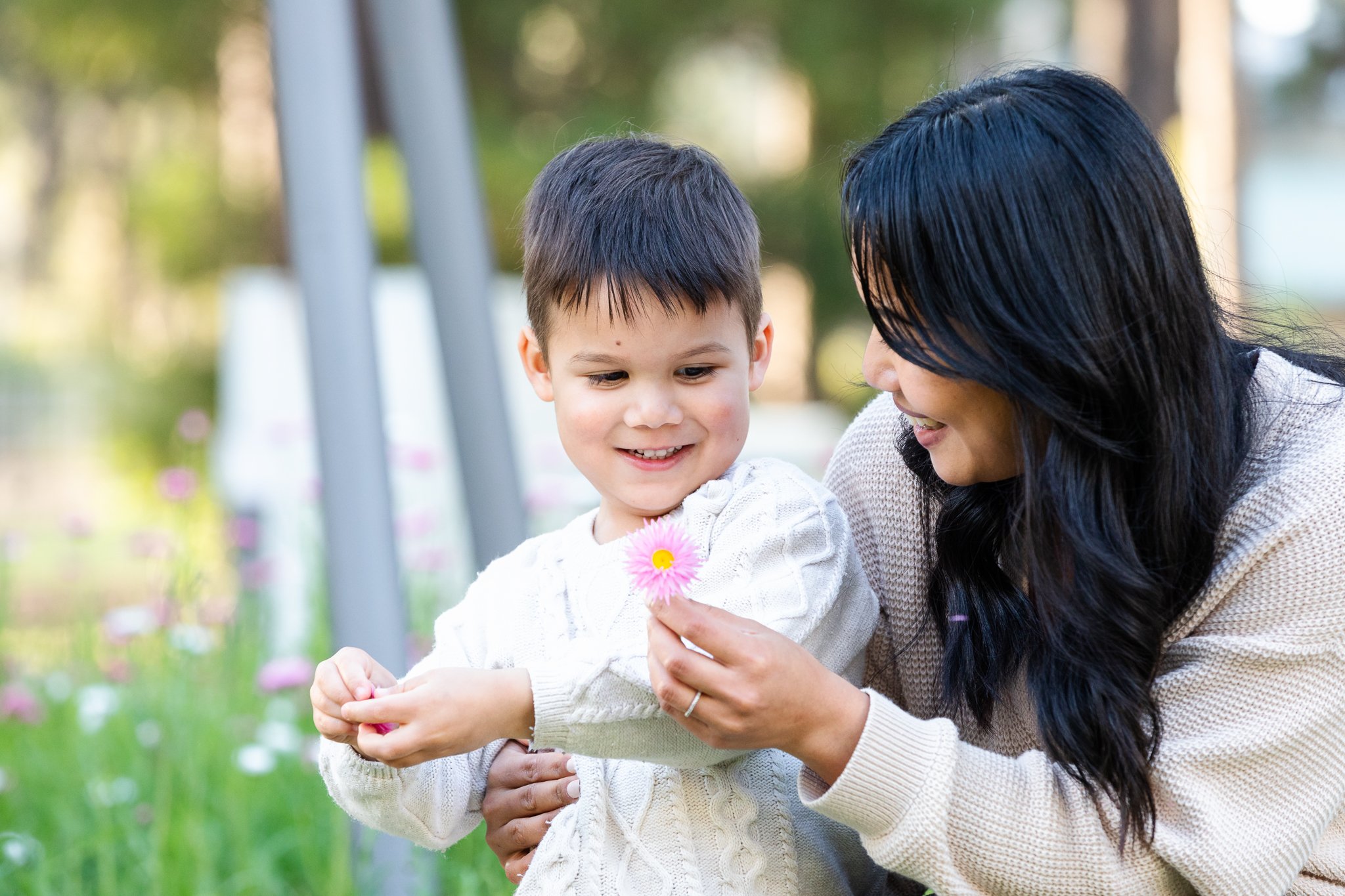
The aim of this study is to improve children's mental health and wellbeing by increasing parents' and carers' confidence and ability to nurture childhood flourishing.
The Flourishing Child study will empower families to identify the areas where their child needs more support through our newly developed ‘Flourishing Check’ and find resources and programs which promote childhood flourishing through our Pathway Tool.
Do you need this page translated in a language other than English? Please email The Flourishing Child team and we'll get in touch to assist you.
Who can participate?
We are looking for 600 parents and primary carers that fit the below criteria:
- You're a parent or primary carer of a child aged 0 to 5 years old (including children up to their 6th birthday)
- You live in the Perth metropolitan area - particularly those that live in Joondalup and Wanneroo
Note, participation in this study will begin in February 2026.
What does participation involve?
If you choose to participate, you will be asked to complete a set of questionnaires taking approximately 45 minutes along with some additional questions across a 6 month period. This includes the following activities which will take between 1.5 to 2.5 hours in total:
- Answer some general questions about yourself, for example, your age, your relationship to the child, your ethnicity, and residential suburb.
- Complete some online questionnaires at various time points throughout the project.
- Complete a newly developed questionnaire, The Flourishing Check, addressing flourishing in early childhood, with the opportunity to provide feedback on usability.
- Participants will then be randomly assigned (like flipping a coin) to one of two groups. Neither you nor the researchers will be able to choose which group you will be in:
Group 1 - Pathway Tool Group: You will receive the 'Pathway Tool' which will contain a wide range of information such as links to evidence-based programs in the Joondalup/Wanneroo area as well as other useful online resources.
Group 2 - Control Group: You will continue to receive your usual care and be invited to complete the 'Flourishing Check' again a few weeks later.
At the end of the project, the control group will also receive the 'Pathway Tool'. All of the above questionnaires can be completed electronically on your personal device and from the comfort of your home at a time that suits you. - A focus group will be conducted with a small selection of participants to understand how you used the 'Pathway Tool' and your experiences with the supports.
We ask that the same parent complete each questionnaire for the same child.
What are the benefits of participating?
To compensate for your time and effort, all participants will be reimbursed with a e-gift voucher via email at relevant time points:
- $40 - Completing the first set of standard questionnaires and the Flourishing Check
- $20 - Re-completing the Flourishing Check a few weeks later
- $20 - Completing questionnaires 6 months after enrolling in the project
- $20 - Pathway Tool group: Completing a questionnaire on using the Pathway Tool
The intervention group will also have the opportunity to participate in a focus group, reimbursed at $50 per hour.
Additionally, by the end of the study, all participants will benefit from receiving information from the ‘Pathway Tool’ which will help you discover programs and resources that enhance childhood flourishing.
How to get involved?
Confirm your eligibility and start participation here.
For more information, read the Participant Information Brochure or contact The Flourishing Child team below:
Ethics approval
Approval to conduct this research has been provided by the University of Western Australia, in accordance with its ethics review and approval procedures. Any person considering participation in this research project, or agreeing to participate, may raise any questions or issues with the researchers at any time. In addition, any person not satisfied with the response of researchers may raise ethics issues or concerns, and may make any complaints about this research project by contacting the Human Ethics Office at the University of Western Australia on (08) 6488 3703 or by emailing to humanethics@uwa.edu.au. All research participants are entitled to retain a copy of any Participant Information Form and/or Participant Consent Form relating to this research project.